Brembo Floating Rotor Replacement
|
by Dave Zeckhausen
Brembo 2-piece rotors use lightweight, billet aluminum hats, attached to iron rotors (called "friction rings") by hardware allowing them to "float" and expand or contract freely with temperature changes. Thus, they are known as "floating rotors."
Rotor (friction ring) attached to aluminum hat by two types of fasteners Although not visible in the photo, the hardware passes through oval slots in the rotor, rather than circular holes. Since iron and aluminum expand at different rates, the slots allow the rotor to expand and contract, unconstrained by the aluminum hat. This reduces stress on the rotors at high temperatures and extends their life. Conventional 1-piece rotors may distort into a cone shape during race conditions, leading to accelerated rotor cracking, soft pedal, and tapered pad wear. Floating rotors have none of these problems. |
|
|
To allow expansion and contraction of the rotors as they heat and cool, the attaching hardware must allow the parts to move, relative to each other. However, the resulting rattle may be unacceptable for a street car. Brembo developed an anti rattle system for the McLaren F1 Supercar, which is still used in many of their street kits. Every other hole location utilizes McLaren anti-rattle springs and spacers to eliminate noise.
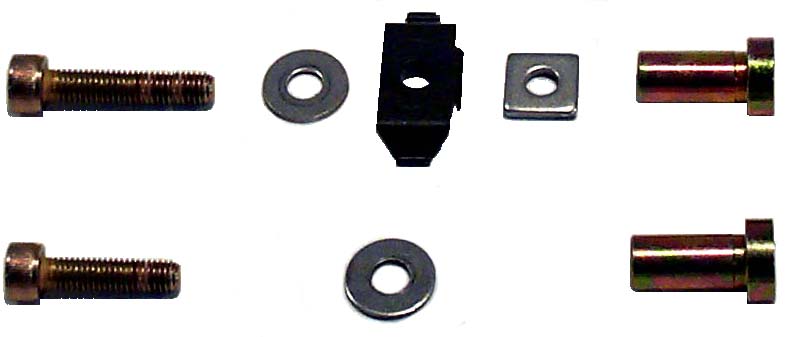
The retaining screw passes through a washer, then a spring clip, then a square spacer and, finally, into the threaded "float bushing" which is inserted through the hat and rotor from the outboard side. The flat edge of the bushing fits against a raised feature on the hat, which prevents it from rotating as the screw is tightened. It is normal for the five screws without spring clips to seem loose. Do not try to tighten them! |

McLaren Anti-Rattle Assembly |
|
Exploded view of the retaining devices used on each rotor assembly. Note that a longer screw is required when the McLaren anti-rattle clip is used and a shorter screw is required otherwise. Each rotor/hat assembly is held in place by 10 fasteners, five of each type. The brass float bushings are shown on the right side of the photo and they are the same, regardless of which type of fastener is used. Assembly Instructions
|
|
|
|
|
|
Just enough thread locking compound is used to fill the bottom 5 or 6 threads
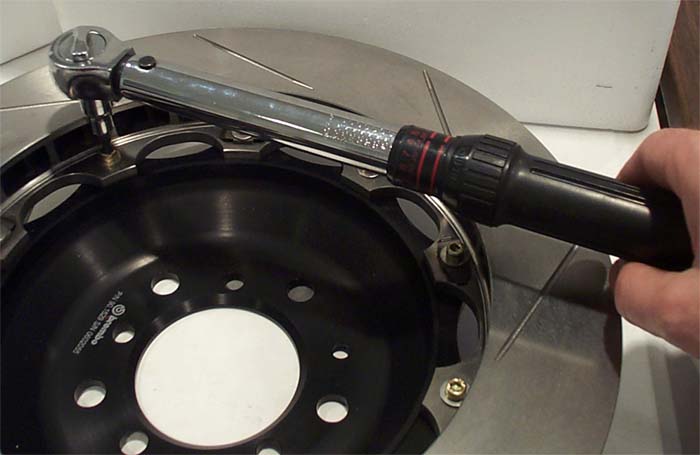
Tightening the rotor screws to 62 inch-pounds of torque
NEW ROTORS MUST BE BEDDED IN. The proper break-in procedure is documented here: Bedding in new pads and rotors If you have any questions about rotor installation or any brake related issues, please call Zeckhausen Racing before you start taking things apart. |
|